
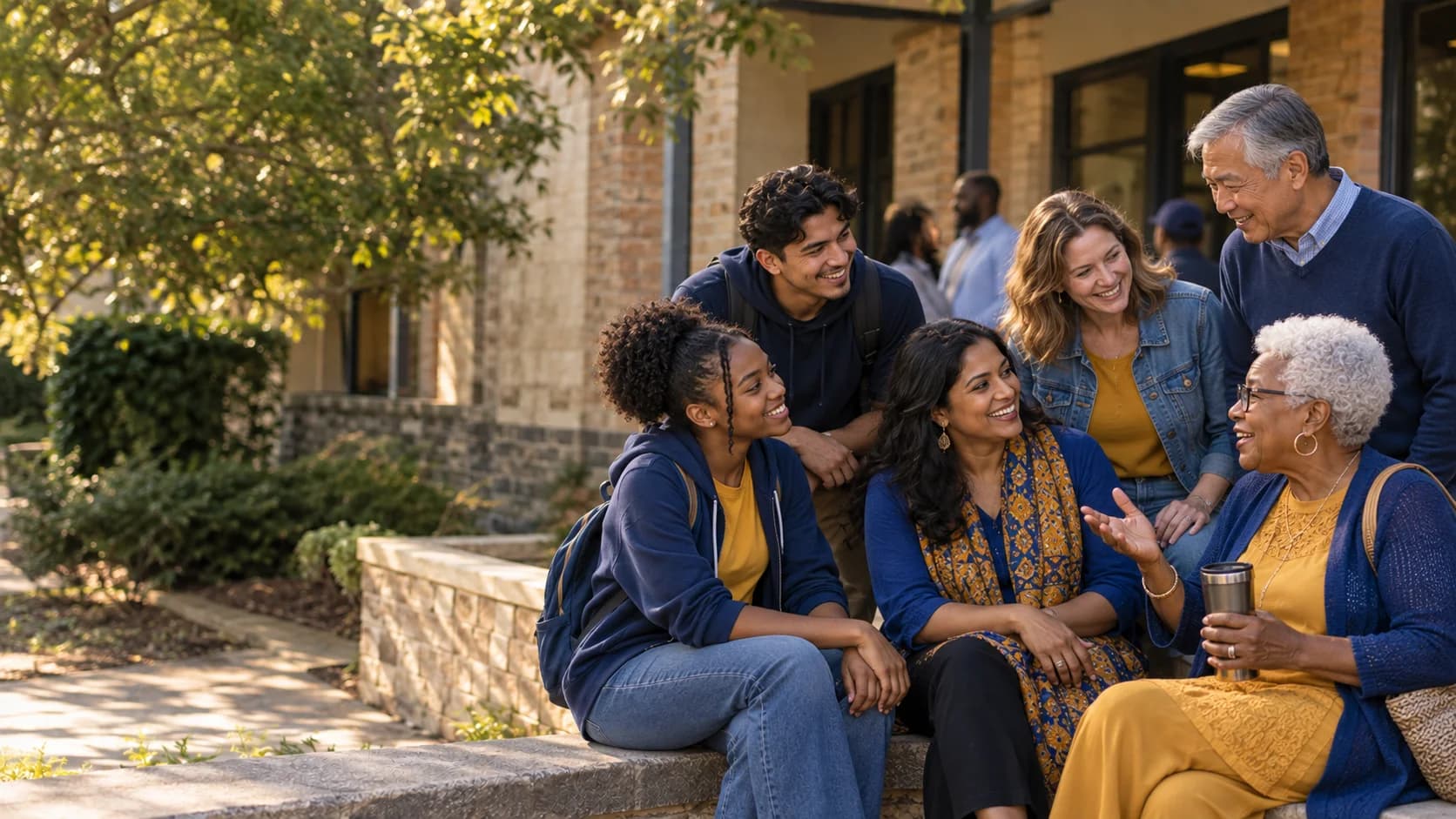
A legacy of service, carried forward.
From Birmingham’s Metropolitan Gardens to classrooms in DeKalb County, our story connects education, family support, and opportunity.
Explore the TCUM LegacyIt began with a commitment to community.
Rev. Dr. Gerald D. Austin, Sr. brought an engineer’s practical approach and a minister’s commitment to service to his hometown of Birmingham, Alabama. The work that became The Center for Urban Missions began in 1985 and was incorporated in 1986, according to his biography.
TCUM’s archived website dates its beginning to 1986. Its early focus was Metropolitan Gardens, a public housing community in downtown Birmingham. The aim was to help families build the skills, relationships, and opportunities needed for greater independence.
Education, work, health, and family life were connected parts of that mission. TCUM served the whole person and the whole family, with an emphasis on partnership, accountability, and lasting change.
From neighborhood roots to a broader mission
1986: The Center for Urban Missions
TCUM established its work in Birmingham, initially serving families in Metropolitan Gardens. Learning, mentoring, and practical family support formed the foundation.
1990: New City Church
Dr. Austin founded New City Church in downtown Birmingham. His biography describes the church and TCUM as connected expressions of reconciliation, community engagement, and service across racial lines.
By 2007: Education, health, and economic opportunity
The archived TCUM website describes three connected areas of work: STARS for educational enrichment, CURE for health and community support, and RAMP for workforce development and entrepreneurship. Its reach had expanded beyond the original neighborhood.
2023: The MEGA legacy renewed
Dr. Austin’s biography records the re-establishment of MEGA INTL Legacy Foundation, formerly The Center for Urban Missions, in 2023. The foundation carried that service tradition forward through Motivation, Education, Growth, and Advocacy.
2026: Pathways to Peace in DeKalb County
The approved school pilot brings this commitment into a 12-week learning experience for grades 6–12. Approximately 150 students are planned across five schools, with MEGA-trained facilitators and a teacher or school administrator present throughout each session.
The purpose continues.
TCUM linked encouragement with practical learning and support. MEGA carries that approach into its current work: helping people recognize their potential, practice useful skills, strengthen their communities, and create opportunities for others.
Pathways to Peace applies that commitment to conflict resolution, empathy, legal awareness, and accountability. Planned participation and evaluation belong to this new chapter; they are separate from the foundation’s historical impact.
Explore Pathways to Peace
Sources behind our story
This history draws on TCUM’s archived 2007 website, Rev. Dr. Gerald D. Austin, Sr.’s biography in MEGA’s records, and the foundation’s current Pathways to Peace program materials. The biography distinguishes the work’s 1985 beginnings from its 1986 incorporation. Historical program descriptions reflect their period.
Discover the TCUM Programs